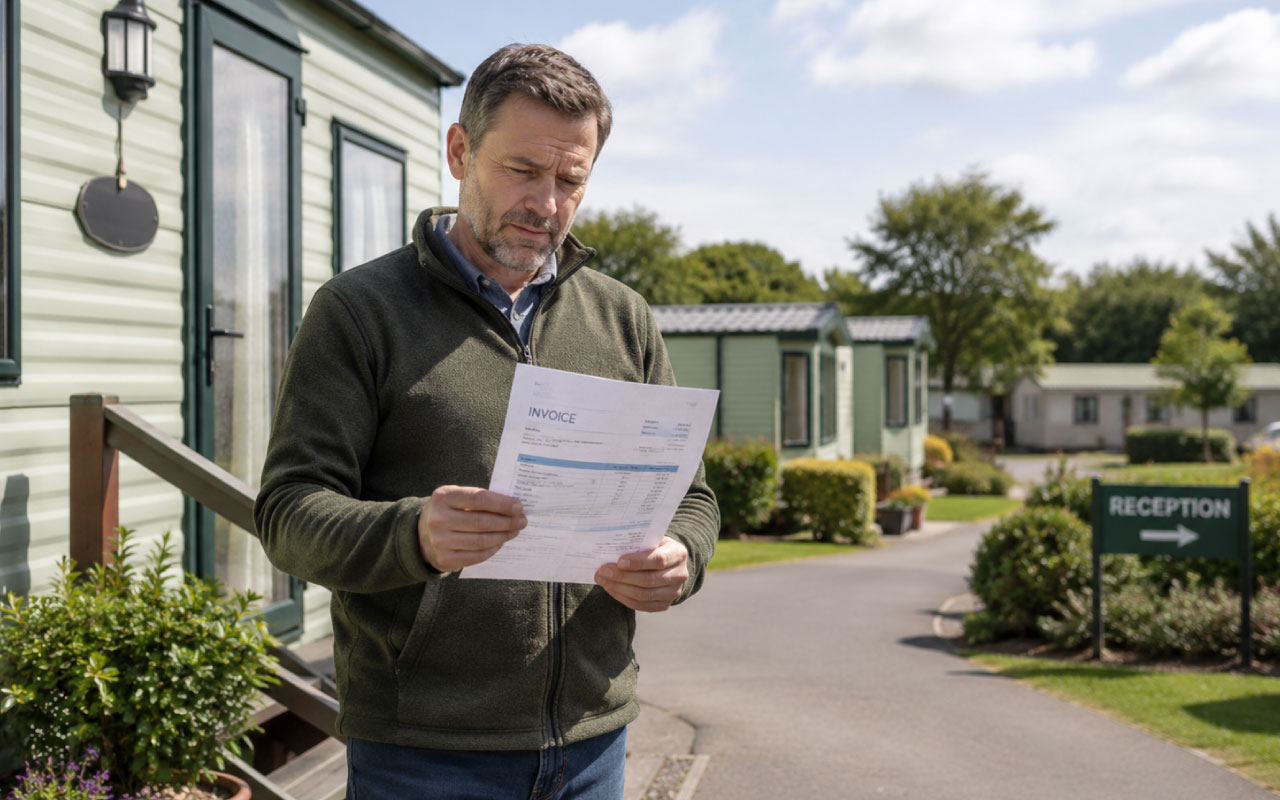
If you've owned a holiday caravan or lodge for any length of time, you'll probably have received an invoice that includes a charge for "rates".
Sometimes it's called "business rates".
Sometimes it's called "council rates".
And sometimes it's simply added to the invoice with very little explanation at all.
Not surprisingly, one of the most common questions we hear at NACO is:
"How do I know if my rates bill is fair?" and “Why’s it so expensive!”
The answer isn't always straightforward because every park operates differently and, as with most things in this industry, the starting point is always your contract.
However, there are some useful principles that every caravan owner should understand.
First Things First – These Aren't ‘Council Tax’
One of the biggest misconceptions is that caravan owners are paying council tax.
In most cases, they're not.
Holiday caravan parks are generally assessed for National Non-Domestic Rates (NNDR), more commonly known as business rates. These are charged by the local authority on the park as a commercial business rather than on individual caravan owners.
The park receives a business rates bill from the local authority and then, depending on the terms of its agreements with caravan owners, may seek to recover some or all of those costs from customers.
That sounds simple enough.
Unfortunately, this is where things can start to become a little murky.
What Should A Fair Rates Charge Look Like?
In broad terms, many caravan owners would reasonably expect that the proportion of rates they pay should reflect the proportion of the rates bill attributable to their caravan pitch.
In other words, if caravan owners collectively account for a certain percentage of the rateable value assessed by the Valuation Office Agency, then collectively they might expect to contribute a similar percentage of the rates bill.
Many parks do exactly that, others use slightly different calculations.
The difficulty is that there is no single piece of legislation that says a park owner must divide rates in one specific way.
Instead, the key question becomes, "What does your contract say"?
If your agreement allows the park to recover rates, service charges or similar costs, the wording of that clause will often determine what can legitimately be charged.
But even where a contract permits recovery of rates, charges should still be transparent, understandable and capable of justification.
If you can't work out where the figure comes from, it's entirely reasonable to ask.
The Most Important Document You've Probably Never Heard Of.
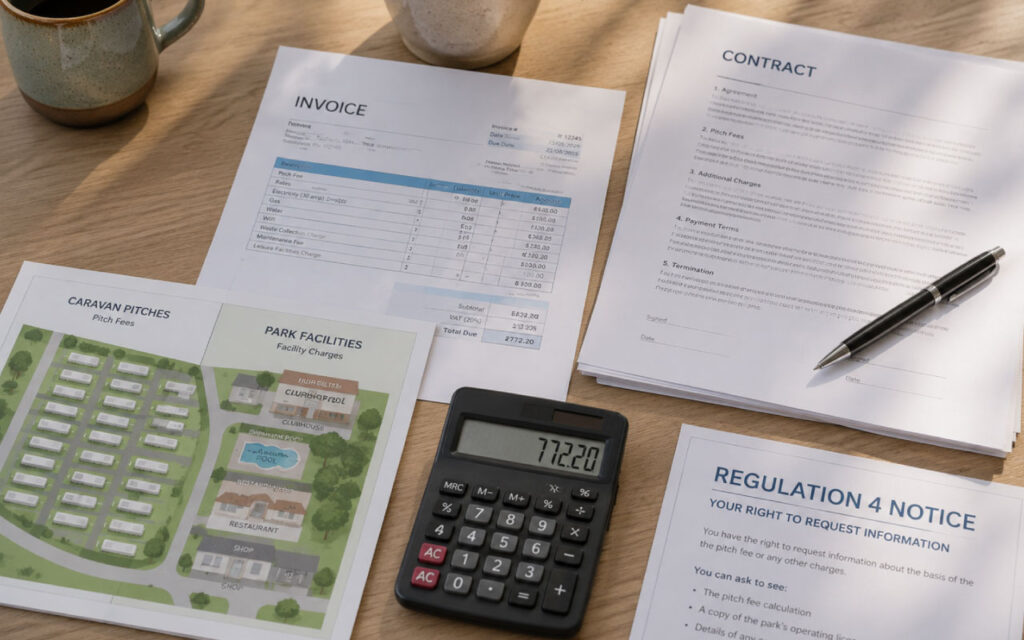
This is where something called a Regulation 4 Notice becomes incredibly useful.
Many caravan owners have never heard of one.
In reality, it can be one of the most valuable documents available when trying to understand rates charges.
A Regulation 4 Notice is issued in connection with caravan park rating assessments and identifies:
- The number of caravans included within the rating assessment; and
- The amount of the rateable value attributed to those caravans and their pitches.
An example notice shows a park with 313 privately occupied caravans and confirms the amount of rateable value specifically attributed to those caravans rather than to the wider park operation.
Why does that matter? Because it helps distinguish between:
Caravan-Related Value
The element attributable to privately owned holiday caravans and their pitches.
Park-Related Value
The element attributable to facilities such as:
- Clubhouses
- Swimming pools
- Entertainment venues
- Restaurants
- Shops
- Reception buildings
- Other commercial activities
These facilities often form a significant part of the overall assessment.
Without seeing the Regulation 4 Notice, it's difficult to understand how much of the rates bill relates to caravans and how much relates to the park's wider business activities.

Can Caravan Owners See The Regulation 4 Notice?
Yes, this is the part that often surprises people.
Occupiers of leisure caravan pitches are entitled to inspect the statement issued by the Valuation Officer relating to the site.
In practical terms, if you're trying to understand how your rates have been calculated, obtaining the Regulation 4 information can be extremely helpful.
Many owners find that once they see the figures, the calculations suddenly start to make much more sense.
Or occasionally, they start asking more questions.
Why Rates Bills Can Differ Between Parks
Not all caravan parks are created equal.
A small family-run site with basic facilities will generally be assessed differently from a large national operator offering:
- Indoor swimming pools
- Entertainment complexes
- Multiple restaurants
- Retail outlets
- Extensive leisure facilities
The rating systems used throughout the UK take account of the commercial value of a site and the income-producing potential of facilities. The valuation methodology for holiday parks can be surprisingly complex and often considers a range of income streams beyond simply collecting pitch fees.
This is one reason why comparing your rates charge with a friend on a different park can sometimes be misleading.
Two caravans of similar size on different parks may be contributing towards very different overall business rate liabilities.
When Should Alarm Bells Ring?
We're not suggesting that every rates invoice is wrong, far from it but, most park operators apply charges that broadly reflect their contractual arrangements and overall rates liability.
However, you may want to ask further questions if:
- Rates increase dramatically without explanation.
- The park cannot explain how charges are calculated.
- The total collected from owners appears significantly higher than the park's actual liability.
- Different owners appear to be charged very different amounts without any obvious reason.
- Requests for clarification are ignored.
A simple question such as: "Could you explain how the rates charge has been calculated and whether it reflects the Regulation 4 assessment?" is entirely reasonable and any professional operator should be able to explain the basis of the charge.
Don't Assume. Ask.
One of the biggest mistakes caravan owners make is assuming that because a charge appears on an invoice, it must automatically be correct. Equally, some owners assume that because they don't like a charge, it must automatically be wrong.
The reality usually sits somewhere in the middle so, before jumping to conclusions:
- Check your contract.
- Review any park rules or supplementary documentation.
- Ask for an explanation.
- Obtain the Regulation 4 information where appropriate.
- Compare the explanation with the actual figures.
Most concerns can be resolved simply by understanding how the calculation has been reached.
The NACO View
Transparency builds trust.
Most caravan owners are perfectly happy to pay their fair share of legitimate costs when those costs are properly explained.
Problems arise when charges appear arbitrary, unexplained or disconnected from the underlying liability.
If you're paying rates, you are entitled to understand what you're paying for and if the explanation doesn't make sense, it's perfectly acceptable to ask for more information.
After all, it's your money and asking questions is usually a lot cheaper than paying charges you don't fully understand.